
Former Kellogg CEO Carlos Gutierrez, Secretary of Commerce under George W. Bush, shares his secret to success in “Sheer Will”
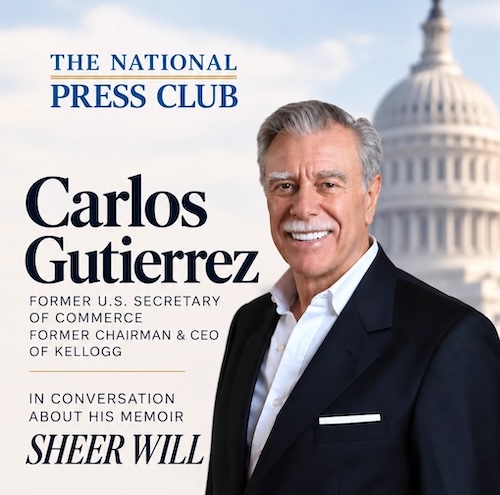
November 2026: A Note from Hope Katz Gibbs, founder, Inkandescent PR + Publishing Co. — I had the pleasure of being the reporter to cover the National Press Club Headliners Book Event on Oct. 8 when Carlos Gutierrez, former CEO of the Kellogg Company and the 35th U.S. Secretary of Commerce from 2005-2009 under George W. Bush, discussed his new book, Sheer Will: Learning to Lead When There Is No Path.
The interview was conducted by Mark Schoeff Jr., the 119th president of the National Press Club and the financial services reporter at CQ Roll Call. Scroll down for excerpts from their Q&A.
Click here to read my article in the National Press Club’s publication, The Wire.
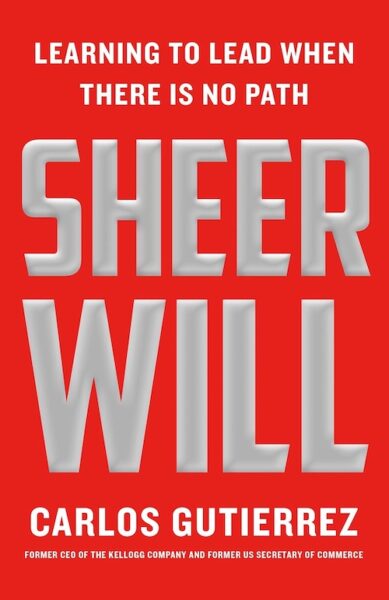 About the book: Carlos Gutierrez has been an influential figure in business and politics for over 35 years, but his route to global leadership was far from the well-worn path of the Ivy League M.B.A. In fact, he never graduated from college and began his life in America without knowing a word of English. When he was only six years old, his family fled the Cuban revolution with almost nothing, traveling to Miami and ultimately emigrating to Mexico.
He began working for Kellogg’s selling cereal out of a van and climbed the ranks until he became the youngest CEO in the company’s hundred-year history. He went on to serve as U.S. Secretary of Commerce for the Bush administration and later held executive roles in nearly a dozen major companies. Despite his humble beginnings and a lifelong struggle with untreated ADHD—he was not diagnosed with the disorder until age 65—he was able to overcome any challenge and reach incredible levels of success.
Gutierrez credits his considerable accomplishments to his relentless positivity and drive to be the best at anything he does. Above all, he holds a steadfast belief that any obstacle should be seen as an opportunity. His working-class background gave him more empathy and appreciation for sacrifice than most business leaders possess. ADHD, while significantly debilitating—particularly in a career track that rewards consistency and organizational skills—granted him a formidable talent for problem-solving and creative thinking, as well as the ability to take bold action with little regard for the risk involved.
Sheer Will is the inspiring story of ambition and courage in the face of seemingly insurmountable odds. Packed with entertaining stories and practical advice, Gutierrez relates his complete journey from his ambitious youth to becoming the most unlikely leader in the history of the U.S. Cabinet. This book is a roadmap for anyone who refuses to be inconsequential and finds themselves traveling an uncommon path in life.
National Press Club: A Conversation with “Sheer Will” author Carlos Gutierrez, former US Secretary of Commerce and former Chairman and CEO of Kellogg
Mark Schoeff Jr.: You mentioned in the book that Kellogg executives are sometimes graded on whether they can produce good copy for marketing and advertising. If you were to boil down the primary message in your book and pitch it readers, how would you crystallize it?
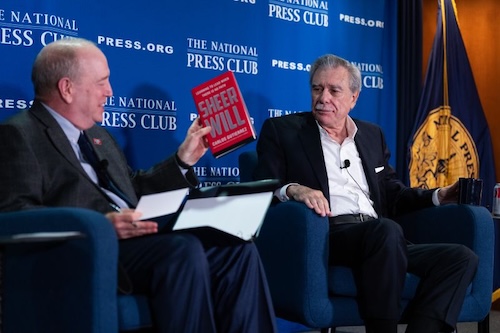 Carlos Gutierrez: Well, I suppose it’s about how a guy who was born in Cuba, who doesn’t have a college degree, started out as a sales guy selling cereal out of a van in Mexico City. He doesn’t find out he has ADHD until decades later, when he is 65. So, how does someone like that become CEO in 25 years? What I tried to do in the book is explain how it was done.
Mark Schoeff Jr.: Let me start with your father’s influence. Pedro Gutierrez is mentioned throughout the book with quotes from him at the beginning of each chapter. He was a prominent businessman in Cuba, but when we fled to Miami, not so much. That always seemed to hang over him. What did you learn from your father?
Carlos Gutierrez: Leaving Cuba was devastating for him. He lost his business. He lost his life. He lost everything that he had been, you know, planning and living for. So, on one hand, I learned everything from him, and I appreciate everything he taught me and how interested he was in me. At the same time, I recognize was a poor man. So, for me it’s very interesting because. I learned that a hero doesn’t have to be rich. When he died, my reaction was: Thank you. Thank you. Thank you for everything that you did.
But he was a hard father. His expectations were high, and we never, ever wanted to disappoint him, which for me is probably the best example of leadership — where you work hard because you don’t want to disappoint; you want to make them proud. From the very beginning, his wisdom always told me that regardless of what I was going through or what I did, “You’ve got a great future.”
Mark Schoeff Jr.: He also introduced you to the food business.
Carlos Gutierrez: He was in the food business, working for Hines, so I wanted to be in the food business. I thought that was just the logical thing to do. He wanted me to study agronomy at the University of California Davis and then get an MBA. He wanted me to really understand nutrition and business. My dream was to be an executive in a food company, and what great luck that the first company I joined was Kellogg’s.
I started off by selling cornflakes out of the van for Kellogg in Mexico City. It was a commission sales job, and for the first three or four weeks I didn’t sell anything — which means I didn’t make anything. I thought, how could I ever be in business if I can’t sell? I knew that I couldn’t fail in this. I realized I was trying to talk like a salesman. I was talking fast. I was trying to be very smooth. And I was scaring people. So, I slowed down and just started talking the way I talk and tried to connect instead of trying to sell. It was a great experience for the corporate world.
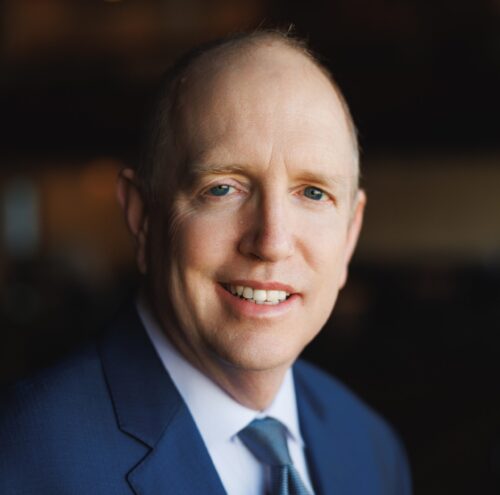
Mark Schoeff Jr., the 119th president of the National Press Club
Mark Schoeff Jr.: How often do the salespeople rise all the way to CEO?
Carlos Gutierrez: At Kellogg, CEOs had all come from sales. But slowly there was an important shift of focus from sales to marketing. In a sense, I was an odd choice. I wanted to succeed. The reason my book is called “Sheer Will” is my belief that we can all make it at some point to 85%. The difference between 15% is will and how badly you want it. I would say that I worked harder than most because if I procrastinated during the day, I took work home. That’s just the way I dealt with it. And luck came my way.
Mark Schoeff Jr.: You also write about the times when your colleagues tried to push you down. You were the victim of some pretty fierce internal politics in Mexico City and in other places where you were stationed. For people who are trying to work their way up the corporate ladder, how do you deal with being pushed down?
Carlos Gutierrez: Yes. I got the job at Kellogg because the general manager was my friend’s father. Everyone knew that. As soon as I came in, I was a target because nobody wants to be working with someone who came in recommended by the general, the CEO of Mexico. That right there just opened up the politics. Anywhere I looked, there was something coming at me. Later on, I found out there were a lot of little plots against me.
What’s interesting is that my career flourished after he left. It’s just one of those things that you think that your job is tied to the person who recommended you, but at the end of the day, when he was not there anymore, I didn’t have the stigma. I was just liberated. It was an interesting lesson.
Mark Schoeff Jr.: Does that have lessons for mentorship — both the mentor and the mentee in a corporate setting or a political setting? How do you navigate that?
Carlos Gutierrez: I think the key is not to be tied too closely to your mentor but to learn from him or her. I have had so many mentors, and I think there are mentors everywhere. It’s a matter of welcoming them. If somebody wants to mentor you, say yes, and welcome them in.
Mark Schoeff Jr.: You asked to be sent to the US, right?
Carlos Gutierrez: I worked for the Kellogg Company for five years in Mexico and had done a pretty good job, but I wanted a new challenge by working in an Anglo market. Why an Anglo market? Why don’t you want to be president of Latin America? Well, because an Anglo market, you know, It’s more competitive. I could learn more.
Mark Schoeff Jr.: That must have given you insight into NAFTA, and international trade generally. What do you think of the president’s current tariff policies?
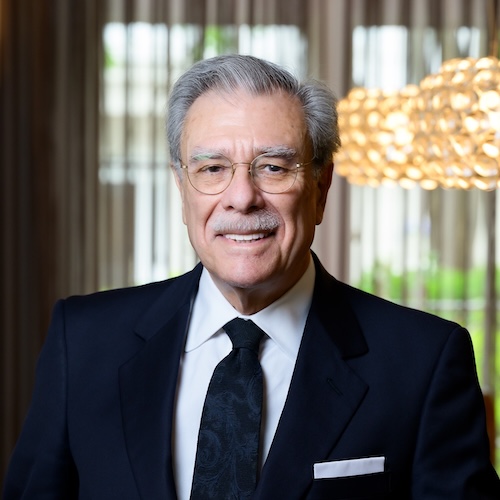
Carlos Gutierrez • Photo by Nathan Hirsch Creative
Carlos Gutierrez: I believe that going across the board is not the way to go. We don’t need tariffs on copper because we can’t make enough copper here in the US right now. Can we be self-sufficient in copper? Maybe in 10 years. We don’t need tariffs on textiles. Are we trying to bring back textiles? Is that what we see as the future of manufacturing in the US? It comes down to what the goal is. Is it to bring back manufacturing? All manufacturing? Do we want textile manufacturing again? Can we be competitive? I think it’s about tariffs protecting the industries of the future instead of trying to bring back the industries of the past, which is sort of what we’re doing with these across-the-board tariffs.
Mark Schoeff Jr.: What was the tariff rate in the Bush administration?
Carlos Gutierrez: In President Bush’s first term, he put tariffs on steel. In his campaign, he heard a lot from the steel workers, from steel companies, and he said, “We have to give we have to get steel companies time to reorganize time to get their act together before we lift those tariffs.” Tariffs were between 8% and 20%. It was supposed to last for three years. After 18 months, they were taken off. Why? Because we had lost more jobs than what we created.
Mark Schoeff Jr.: In your book you talk about communication and transparency as being important for leadership. Why those two traits?
Carlos Gutierrez: I’ve been thinking about leadership all my life and I’ve come to the conclusion that people have to trust you as a leader. This is not about personalities or how you look and ethnicity. It has nothing to do with that. Do they trust you? Do they trust that what you’re saying is true? Do they trust that you’re going to have the courage to make the tough decisions when you have to? Do they trust that you believe in something bigger than yourself? Things that create trust and transparency are important, as well. Communication, transparency, showing up, just giving people the chance to throw some tomatoes at you once in a while — that helps.
Mark Schoeff Jr.: When those tomatoes were on their way toward you, did you did you try to dodge them, or did you just take the hit?
Carlos Gutierrez: I think I did the equivalent of standing in front of it. When the questions come, let them come. Maybe that’s an advantage that I have. It doesn’t matter to me what question you ask. In fact, I think in an organization, it’s healthy to be able to ask the CEO any question you want. It’s that kind of an environment.
Mark Schoeff Jr.: What was the toughest room you had to address — as a whether CEO of Kellogg’s or at lower executive level executive management levels? Was it workers on the factory floor or your executive peers in the boardroom?
Carlos Gutierrez: I’d say the toughest for me as CEO was the financial community — Wall Street, analysts and investors, because those are the people who determine your stock price. A recommendation by them to sell will tank the stock price. I spent a lot of time talking to them, probably 10 to 15% of my time. I’m the only one who could do that, right? The CEO. So, if the CEO doesn’t do that, who is talking to investors? I saw that as a as a key part of my job, and that was the toughest.
Mark Schoeff Jr.: Why were they the challenge?
Carlos Gutierrez: They were skeptical about the company. They were skeptical about my ability to turn around the company. They have their models and were always looking for something to nitpick. Anytime we had a bad month or a bad quarter, they would just say, “Yeah, we told you so. This isn’t going to work.” That skepticism also made it more pressure-filled for the board.
Mark Schoeff Jr.: Did you think the analysts were fair to tell us?
Carlos Gutierrez: I know some of them did not understand the business. Some analysts were 28 years old; very smart, very well educated, but they didn’t have a sense for you know the nuances and what it takes to run a company, and that could be frustrating. But some of them were outstanding and would give you analysis that you hadn’t seen about your company.
Mark Schoeff Jr.: What are the differences between talking to an analyst and talking to a journalist?
Carlos Gutierrez: Analysts try to get you to give them information so they can build their models; they want very detailed information. Journalists ask questions to get information and once in a while to put the interviewee on the spot. It’s a different goal. The questions are tough but different goal.
Mark Schoeff Jr.: When you were CEO of Kellogg, you introduced a new framework emphasizing higher margins rather than volume. Why did you do that?
Carlos Gutierrez: Anyone who has worked at Kellogg would know about its obsession with volume. WK Kellogg used to say there are very few problems that can’t be solved with another carload. Volume. Volume, right? Sell pounds. Sell kilos. And at the end of a quarter, make sure you sell them. Even if you have to discount them. The important thing is the pounds sold.
I thought that was kind of ridiculous because you’re selling a lot, but you don’t make as much as you do when you sell less because you’re giving it away. When you’re going after the pounds, you’re going after this metric that doesn’t really mean anything. When I said, ” Let’s forget pounds, it was a tough sell because it was in the corporate DNA.
We used to design products to be heavy so we could sell pounds, but because they’re heavy, they had lower margins. It seems like light products had higher margins, but the light products had better margins and a better price.
When we went to the analysts and investors, we said, “We’re not going to measure market share in volume anymore.” The first thing I said, “Well, that means you’re number two.” Okay, if that’s what it means, that’s what it means. But we’re going to measure dollars. And we recaptured dollar, or we captured dollar market share leadership in about 12 to 18 months.
Mark Schoeff Jr.: Today’s CEOs also want higher margins but we’re now in a highly inflationary market and companies are gaining advantages by trying to pass less of that on to the consumer, which presumably lowers margins. What do you tell today’s CEOs who want higher margins?
Carlos Gutierrez: To get higher margins, I think that just makes inflation worse. You know what happens? If inflation is 3.4%, that means you have to raise your prices at least 3.4% to stay even unless you can take cost out.
What I recommend to someone running a company is if you have to protect margins and you have to take a price increase to protect margins, take it, because you will never get those margins back. After inflation starts coming down, you’ll be the only one raising prices because you got caught. I’m not saying gouge, but you have to protect the company. You have to protect the margins of the business.
Mark Schoeff Jr.: You also said in the book that one of the traits you brought to being CEO was pragmatism. Tell us about that. How are you pragmatic?
Carlos Gutierrez: Because I didn’t have frameworks and tools that I would have learned getting an MBA, I just tried to be practical about it. In Mexico, when I got into this to the business, it was in bad shape. We had to close a plant, and my question was, how do I fix this? You know, it wasn’t how do I set a long-term strategy? It was how do I fix this?
And then the thinking was, what do we want people to do? How do we measure what we want them to do? Let’s do that and then let’s share information with everyone. That was essentially what we did. Just transparency and information. Everyone had what I had. I was criticized because you don’t normally do that, but I thought it was the way to go.
Mark Schoeff Jr.: So, you weren’t burdened by the latest theory from business school. You didn’t get a college degree at all. And yet you’ve succeeded to the point that you’ve written this book for us. That leads to a question that colleges and parents and kids are wrestling with today, maybe more so than in a generation or more. Do kids today need to go to college?
Carlos Gutierrez: Yes, I would recommend going to college so that you don’t regret it for the rest of your life. I co-founded a startup called EmPath that uses AI and machine learning to infer employees’ skills. What we’re seeing more and more is that, at the end of the day, it’s not so much where you went to school, but what you learned. What are your skills, right? I think skills will be the key measure in the future.
Where’s the best place to develop the skills? Is it college, or is it somewhere else? I think college gives you a foundation. College does two things for you. One is it teaches you how to learn, right? You learn how to learn. Every individual probably learns in a different way. So, when you get into the corporate world, you know how to learn. You learn how to learn in college.
The other thing is you learn what you love and you learn what you’re good at. University did that for me. I don’t have a degree, but I went to community college and found I was pretty good at public speaking. I didn’t know that. Then at another university in Mexico, I learned that I love financial accounting. Those were my skills.
Mark Schoeff Jr.: President George W. Bush offered you a chance to join his administration, and you shifted your focus from things like quarterly reports to promoting the president’s agenda. In Washington, there are a lot of people, who in my experience, especially on Capitol Hill don’t know what the business world is like. How did you compare what are the biggest similarities and differences between the Department of Commerce and Kellogg’s?
Carlos Gutierrez: Generally speaking, I found that business is harder than politics, where very often, people get by through perception. How are you perceived? Are you perceived to be a good leader? Are you perceived to care about certain things? In business, there’s no perception. Either you have the results or you don’t. You can be perceived however you want, but the pressure is a lot harder. It’s weekly market share, it’s monthly, this, it’s quarterly that, it’s a stock price, it’s every day.
I found some great people in government, especially the career people — they are amazing. We’d be sitting in a meeting, and somebody has a question about, say, Argentina. You call a desk officer in Argentina and there’s nothing you can ask that person about Argentina that they don’t know. We have some real specialists in our government, and that’s a big part of our advantage. These people are amazing.
The CEO of the executive branch is the president, and he has, or he still has, a board of 535 people, right? The Senate plus the House — and half of those people want him to fail, right? You start there. That’s the environment that you put a president into. And then the president can’t manage the executive branch the way he wants because there are all these regulations and rules that have to go through Congress.
Mark Schoeff Jr.: The current administration, though, is trying to significantly reduce those career staffers who you just praised. What do you think of this administration’s stance toward the career government staffers?
Carlos Gutierrez: They are very talented people. Here’s the dilemma, which I talk about it in the book. A senator from the private sector came to me and said, let’s get together and close the Commerce department. I knew they weren’t serious because I think they just wanted to be able to associate themselves with cost reductions. I just said, “No, we have a department. We have things to do. We have things to contribute, trade, etc.”
But you take education. I’m getting into an area here that’s not mine. But this is the debate that we need to have, right?
When we opened the education department, our level of education was higher than it is today. Is it related? I don’t know. But my goodness, we should ask, right? I hope they looked surgically at each one and decided who what jobs were not needed. That’s really the key. What work do we not need? Not what people do we want to fire. What work do we not need?
If there’s work that was found that is really legitimately something that is not adding value to anyone. then I think it needs to be looked at. But I don’t think it’s an across-the-board thing.
Mark Schoeff Jr.: How do you think DOGE did in addressing those very questions you brought up?
Carlos Gutierrez: DOGE did not did not deliver the goods, right? By the way, I’m not a proponent of DOGE. What DOGE did is create the awareness of waste, of abuse. Granted, some of those were exaggerated.
But here’s the thing: We have a deficit that should worry us all. Every single voter should be worried about the fact that our interest payments on our debt are higher than what we spent on defense; 6% of our GDP is debt. That it’s higher than we had during Bush. You have to go back to Vietnam or the financial crisis to see when things went out of kilter. It’s a very high deficit. Mexico is 2%, just to give you a sense of proportions. We’re going to have to deal with that one day. Either you cut entitlements or you raise taxes.
Mark Schoeff Jr.: Do you think Congress will ever have the political will to make that decision?
Carlos Gutierrez: We’re going to have to. We’re going to be forced to dress it. Right now, everybody’s talking about how bad it is that our 10-year interest rates so high. People want to know that if I’m going to give you my money, you have to pay me a little bit more. This is the US. I mean, there’s nothing safer in the world. What happens as the deficit gets larger and we have to continue to borrowing money? It’s just unbelievable. We you know as a business the US governments operates at a loss. It’s just basic, the way it’s working.
Mark Schoeff Jr.: You were a leader in formulating President Bush’s immigration policy. What do you think about what the Trump administration is doing on that issue?
Carlos Gutierrez: I was asked this yesterday. The first thing I said is I believe in immigration. I am a big proponent of immigration. I think this is it’s part of our DNA. That doesn’t mean I believe in illegal immigration. I don’t know anyone who says, “Yeah, let’s just open the borders and let everybody in.” And my concern is that that focus on illegal immigration has spilled over to a criticism on immigration at large in some areas. I think that’s a big mistake. We are the original nation of immigrants.
We’re competing with China. China doesn’t have immigration. They don’t understand it. They don’t get immigration. Chinese are centralized and Chinese. That’s not what we do. We’re decentralized, and we attract the best and the brightest and the hungriest from all over the world. We shouldn’t give that up. We should double down on that instead. I hope that we take a strategic view about immigration at large, which is what President Bush wanted to do.
Mark Schoeff Jr.: Here’s a question from the audience. When you look at today’s global landscape, what concerns you?
Carlos Gutierrez: One thing that concerns me is that traditional politicians like you find in Europe — the UK, France — are kind of center moderate. Those types of politicians appear a little bit quaint these days, a little bit boring. What are they going to do for us? Come on. This we’ve seen this before. This is another Davos conversation. We don’t we want something new. That is happening. So, I think it’s just going to extremes either to the right or to the left. And that’s a dangerous thing.
I’m obviously worried about the war. I’m worried about inflation. I’m worried about the economy. And I’ll tell you the one thing that worries me the most about our economy is the stock market because our economy grows based on consumer spending. Consumers are spending because they bought Nvidia 5 years ago and they’re saying feel wealthier than I ever have. So, I’m going to spend; I’m going to enjoy it. If that market declines, if it takes a crash, if it takes a dive, that will impact the economy.
Mark Schoeff Jr.: Do you think do you think AI is a bubble? Is it going to burst?
Carlos Gutierrez: No, I’m a I’m a big believer in AI. I think it’s an exciting time to be alive. I think it’s a wonderful thing. I know that there are concerns. There should be. But there will be entrepreneurs, there will be companies, there will be a lot of people who will create models in order to combat rogue agents. It’ll happen. We will be fighting with rogue agents and with AI for the rest of our lives. Just like cybersecurity, corporate companies will never win the cybersecurity war. It’s just an unwinnable war. It’ll never stop. What you can do is make sure we don’t lose too many battles. I think AI is going to be the same.
Mark Schoeff Jr.: What the appropriate role for government when it comes to AI?
Carlos Gutierrez: Oh boy. Regulate when you when you see something that is of safety. It’s of national interest to society. But my concern is that it’s going to be a thousand-page bill and it’s going to it’s going to hold back our companies. Private sector free enterprise AI was created by seven US companies. AI was brought to the world and it’s being led by US companies and it’s all about US private sector, right? That is an amazing thing. The other thing, too, is I think this is a wonderful scenario for a relationship with China.
Mark Schoeff Jr.: If this were a normal administration, these are normal times, what would be happening?
Carlos Gutierrez: Well, AI regulation would be the theme of the day. Congress would be working on that 10,000page bill. The UN would have an AI commission that we would have to abide by global regulations. Davos would talk about it. That’s where we would be today. We are leading. We’re being aggressive. We’re taking risks. But I personally agree with the stance that it’s better to underregulate than to overregulate today.
Mark Schoeff Jr.: That kind of puts you toward the White House’s stance.
Carlos Gutierrez: I don’t know how far they are, but I’m on that side.
Mark Schoeff Jr.: Right. So, you said if today were a normal political atmosphere, or at least that’s what I extrapolated you’re saying, is it fair to call you a traditional Republican, a traditional conservative?
Carlos Gutierrez: Yes. Okay. Traditional Republican. Yeah.
Mark Schoeff Jr.: What do you think of Donald Trump’s Republican Party?
Carlos Gutierrez: It’s different than anything I knew. You know, we I mean, I grew up in a Republican party and we were free traders. Immigration is part of our DNA, right? It’s just a different thing. The thing that Trump has brought, which I think future presidents will have to live with, is this idea that a president’s hands are tied and can’t do anything. Congress he’s just plowed ahead.
I can imagine in the future a president saying, “Well, my hands are tied, Congress. President Trump would have done it, right, so it really is almost a new standard for the executive branch.” We’ll have to see where it goes. But this is run like a corporation. Decisions. Forget about having to go through someone else.
Is that good, bad, or indifferent? I don’t like it. I don’t like it because that’s not the system. I just hope people who will justify this will say, “Look, Trump is doing things no one else has ever done.”
And yeah, okay, we have to put up with some things, but who else would take on the things that he’s doing? That’s the justification for what is going on, for example, with illegal immigration. If it’s not Trump, no one’s going to do it right it. It’ll be an interesting evolution, but I do think that the presidency has changed.
Mark Schoeff Jr.: Are Republicans in Congress doing enough to uphold Article One during the second Trump administration?
Carlos Gutierrez: Well, we do have to recognize that in terms of the use of power, President Trump is a master. He understands it, and he will use it. He’s not bashful about using it. To be in the Republican Party, you’ve got to be aligned, and he has the support he has around the country where he can actually say: Don’t vote for that person, and that person’s career is gone.
Republicans obviously are concerned. Now there will be those who have to answer to certain things. You said something in Congress that was happening, and it really isn’t. And right, we’ll see how that shakes out.
Mark Schoeff Jr.: Who would you like to see be the Republican nominee in 2028 for president?
Carlos Gutierrez: I like Marco Rubio. I think he’s a very talented public servant.
Mark Schoeff Jr.: He wants regime change in Cuba. What do you think of that idea and what do you think of the way that they’ve pushed for it so far?
Carlos Gutierrez: I think everyone wants change in Cuba. If one of the options for Cuba was a China model, my fellow exiles don’t like that because if the China model works, then who gets the credit? The communists. I really don’t care who gets the credit. I just want Cubans to experience some prosperity. That’s always been the stigma that the hardline in Miami will not even talk to Cubans in Havana. That is blasphemy. That is being a traitor.
Mark Schoeff Jr.: We’ll talk about that in a second, the hardline in Miami. Is Marco Rubio part of that hardline?
Carlos Gutierrez: Yes. They’re very influential. They’re extremely influential. I write in the book that when President Obama tried to normalize relations with Cuba, at first, I said this was a terrible idea. I wrote an op-ed saying this is bad, but then people were opening businesses in Cuba. It looked like they were going in the right direction.
I just said if it’s Cuba, I want to get involved. I wrote an op-ed supporting what was going on. I was asked to become the chairman of the US Cuba Business Council, which I said yes to, and I enjoyed it very much. I went to Cuba for the first time in 50 years. The only problem is I lost friends. My wife lost friends. Eddie lost friends. Karina lost friends, and Erica lost friends. That’s how emotional this thing is, you know.
But I ask if we want regime change, and we’re trying to do it in a non-military way. How can you do that if you’re not going to talk to these people? Right? I went down, I met them, and I talked to them, and I mentioned in the book that the first time I had met a Cuban communist, and actually Cuban communists are very similar to Cuban capitalists. We talk about family; we like jokes. But how can we actually get involved with that and talk to these people so that we can fuel change?
Mark Schoeff Jr.: How difficult is life right now for Cubans?
Carlos Gutierrez: Oh, very tough. It’s just extremely tough. It’s the economic part. It’s very hard to get the basics — food, medicine, very hard. Electricity was gone for like I know months on and off. It was pretty severe. So yeah Cuba, it’s tough. It’s a very tough system. I remember Cuba in 1959, after the revolution, there was so much hope and so much excitement. What I see now I kind of a bored society. Just bored, exhausted. Just where’s it going? There’s not much to do in Cuba. Just kind of a boring place.