
Former Kellogg CEO Carlos Gutierrez, Secretary of Commerce under George W. Bush, shares his secret to success in “Sheer Will”

November 2026: A Note from Hope Katz Gibbs, founder, Inkandescent PR + Publishing Co. — I had the pleasure of being the reporter to cover the National Press Club Headliners Book Event on Oct. 8 when Carlos Gutierrez, former CEO of the Kellogg Company and the 35th U.S. Secretary of Commerce from 2005-2009 under George W. Bush, discussed his new book, Sheer Will: Learning to Lead When There Is No Path.
The interview was conducted by Mark Schoeff Jr., the 119th president of the National Press Club and the financial services reporter at CQ Roll Call. Scroll down for excerpts from their Q&A.
Click here to read my article in the National Press Club’s publication, The Wire.
Coming this month: Stay tuned for our interview with Sec. Gutierrez and Jeffrey James Higgins when the “Sheer Will” author stars on the next podcast/video episode of Elaine’s Literary Salon.
 About the book: Carlos Gutierrez has been an influential figure in business and politics for over 35 years, but his route to global leadership was far from the well-worn path of the Ivy League M.B.A. In fact, he never graduated from college and began his life in America without knowing a word of English. When he was only six years old, his family fled the Cuban revolution with almost nothing, traveling to Miami and ultimately emigrating to Mexico.
He began working for Kellogg’s selling cereal out of a van and climbed the ranks until he became the youngest CEO in the company’s hundred-year history. He went on to serve as U.S. Secretary of Commerce for the Bush administration and later held executive roles in nearly a dozen major companies. Despite his humble beginnings and a lifelong struggle with untreated ADHD—he was not diagnosed with the disorder until age 65—he was able to overcome any challenge and reach incredible levels of success.
Gutierrez credits his considerable accomplishments to his relentless positivity and drive to be the best at anything he does. Above all, he holds a steadfast belief that any obstacle should be seen as an opportunity. His working-class background gave him more empathy and appreciation for sacrifice than most business leaders possess. ADHD, while significantly debilitating—particularly in a career track that rewards consistency and organizational skills—granted him a formidable talent for problem-solving and creative thinking, as well as the ability to take bold action with little regard for the risk involved.
Sheer Will is the inspiring story of ambition and courage in the face of seemingly insurmountable odds. Packed with entertaining stories and practical advice, Gutierrez relates his complete journey from his ambitious youth to becoming the most unlikely leader in the history of the U.S. Cabinet. This book is a roadmap for anyone who refuses to be inconsequential and finds themselves traveling an uncommon path in life.
National Press Club: A Conversation with “Sheer Will” author Carlos Gutierrez, former US Secretary of Commerce and former Chairman and CEO of Kellogg
Mark Schoeff Jr.: You mentioned in the book that Kellogg executives are sometimes graded on whether they can produce good copy for marketing and advertising. If you were to boil down the primary message in your book and pitch it readers, how would you crystallize it?
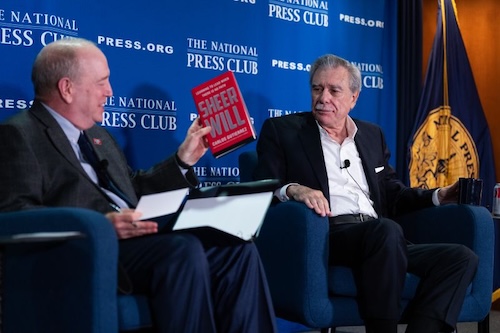 Carlos Gutierrez: Well, I suppose it’s about how a guy who was born in Cuba, who doesn’t have a college degree, started out as a sales guy selling cereal out of a van in Mexico City. He doesn’t find out he has ADHD until decades later, when he is 65. So, how does someone like that become CEO in 25 years? What I tried to do in the book is explain how it was done.
Mark Schoeff Jr.: Let me start with your father’s influence. Pedro Gutierrez is mentioned throughout the book with quotes from him at the beginning of each chapter. He was a prominent businessman in Cuba, but when we fled to Miami, not so much. That always seemed to hang over him. What did you learn from your father?
Carlos Gutierrez: Leaving Cuba was devastating for him. He lost his business. He lost his life. He lost everything that he had been, you know, planning and living for. So, on one hand, I learned everything from him, and I appreciate everything he taught me and how interested he was in me. At the same time, I recognize was a poor man. So, for me it’s very interesting because. I learned that a hero doesn’t have to be rich. When he died, my reaction was: Thank you. Thank you. Thank you for everything that you did.
But he was a hard father. His expectations were high, and we never, ever wanted to disappoint him, which for me is probably the best example of leadership — where you work hard because you don’t want to disappoint; you want to make them proud. From the very beginning, his wisdom always told me that regardless of what I was going through or what I did, “You’ve got a great future.”

Mark Schoeff Jr., the 119th president of the National Press Club
Mark Schoeff Jr.: I believe he also introduced you to the food business.
Carlos Gutierrez: He was in the food business, working for Hines, so I wanted to be in the food business. I thought that was just the logical thing to do. He wanted me to study agronomy at the University of California Davis and then get an MBA. He wanted me to really understand nutrition and business. My dream was to be an executive in a food company, and what great luck that the first company I joined was Kellogg’s.
I started off by selling cornflakes out of the van for Kellogg in Mexico City. It was a commission sales job, and for the first three or four weeks I didn’t sell anything — which means I didn’t make anything. I thought, how could I ever be in business if I can’t sell? I knew that I couldn’t fail in this. I realized I was trying to talk like a salesman. I was talking fast. I was trying to be very smooth. And I was scaring people. So, I slowed down and just started talking the way I talk and tried to connect instead of trying to sell. It was a great experience for the corporate world.
Mark Schoeff Jr.: How often do the salespeople rise all the way to CEO?


